A Warrior's guide to Machine Learning — 1
A fantasy-styled journey from math fear to machine learning fundamentals. Learn linear regression, slopes, and error measurement through a dragon-fighting story designed for beginners.

I’m a software engineer with 5+ years of experience building and maintaining large-scale, production systems. My work centers on backend architecture, distributed systems, and improving system performance, and I’m expanding into machine learning, LLMs, and agentic AI.
I also have hands-on exposure to frontend development and IoT systems at a foundational level.
Beyond engineering work, I enjoy reading books, playing guitar, listening to music, writing technical blogs.
Technologies I have worked with
 Python
 Opentelemetry
 Machine learning
 Langchain
 VertexAI
 MLflow
 Kubeflow
Some of my recent work
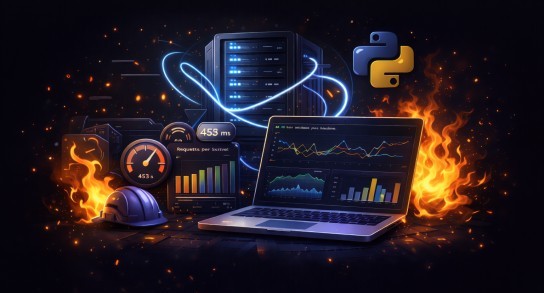
A simple load testing library built from scratch in Python. Features real-time metrics and custom scenario scripting. Built to understand load testing in depth.

A custom ASGI server built from scratch to understand async web server internals and the ASGI specification.
Thoughts on technology, development, and innovation

A fantasy-styled journey from math fear to machine learning fundamentals. Learn linear regression, slopes, and error measurement through a dragon-fighting story designed for beginners.

Understanding Retrieval-Augmented Generation and its impact on large language model performance in specialized applications.
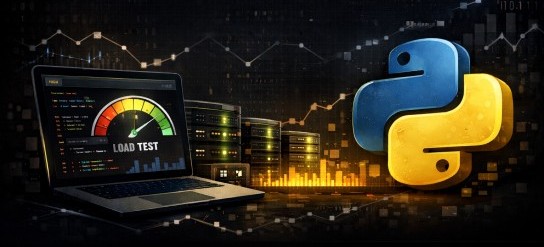
A step-by-step walkthrough of building a minimal load-testing tool in Python, inspired by Locust. The blog covers async user simulation with asyncio, real-time metrics collection, and a clean, extensible design—perfect for understanding how load-testing tools work under the hood.

A deep dive into building a minimal ASGI server from scratch using Python’s asyncio, starting from raw sockets to a working ASGI implementation. The post explains HTTP parsing, the ASGI interface, and shows how the custom server can successfully run a FastAPI application without Uvicorn.
This post challenges the traditional ACID definition by arguing that consistency is not a database guarantee but an application responsibility. It explains ACID properties, real failure scenarios, and shows why only atomicity, isolation, and durability are enforced by databases, while consistency depends on how transactions are designed.
Have a problem worth solving?